

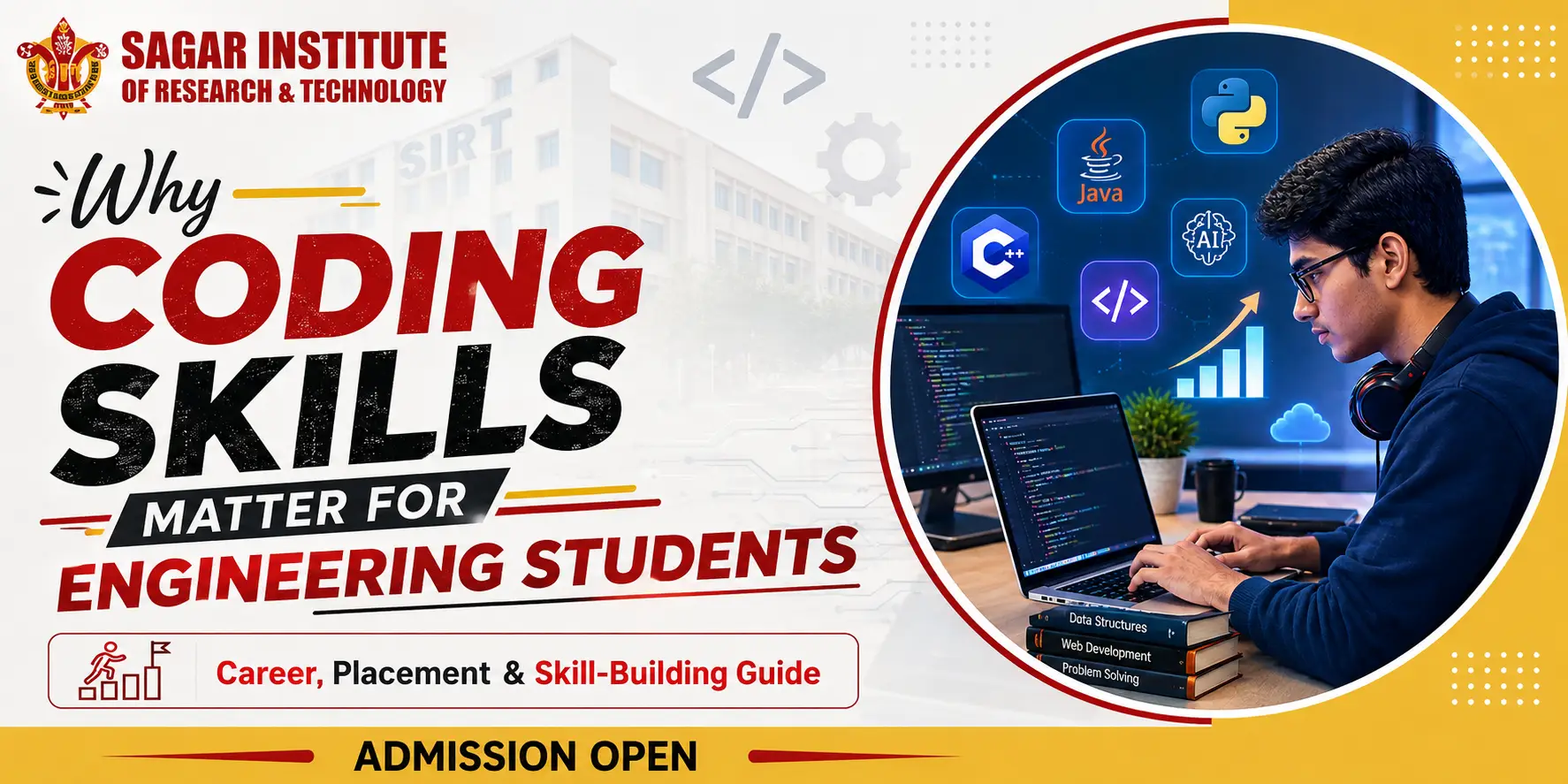
A B.Tech degree can open the door to a wide range of technology careers, but academic knowledge alone may not always be enough to prepare students for technical roles. For engineering students, coding is one of the most important practical skills to develop during college.
Students who regularly practise programming can strengthen their logical thinking, problem-solving abilities, and understanding of how software works. Coding practice also gives students an opportunity to build projects, participate in hackathons, prepare for technical interviews, and explore different technology careers.
The importance of combining technical and human skills is also reflected in the World Economic Forum's Future of Jobs Report 2025, which identifies analytical thinking as a leading core skill and highlights AI, big data, networks and cybersecurity, and technological literacy among the skills expected to grow in importance.
For B.Tech students, therefore, coding should not be viewed only as a subject to clear in an examination. It is a skill that can be developed progressively and applied throughout an academic and professional journey.
Quick Answer
Coding skills help engineering students build problem-solving ability, prepare for technical interviews, and access careers in AI, data science, cybersecurity, and software development. Alongside DSA and hands-on projects, coding forms the core of most technical placement processes and is one of the most valuable skills to develop during a B.Tech degree.Table of Content
1. Why Coding Skills Matter for Engineering Students
2. Coding Skills Employers Look For
3. How Coding Skills Help With Placements
4. Coding Skills and Career Opportunities
5. How Students Can Improve Their Coding Skills
6. Coding Practice Roadmap for Engineering Students
7. Common Mistakes Students Make While Learning Coding
8. FAQ About Coding Skills for Engineering Students
9. SIRT Bhopal: Helping Engineering Students Turn Coding Skills into Practical Experience
1. Why Coding Skills Matter for Engineering Students
Coding is the process of using programming languages to give instructions to computers and build software, applications, websites, tools, and other digital solutions.
For engineering students, learning to code can provide several benefits:
1. Builds Problem-Solving Skills
Programming teaches students to break a complex problem into smaller, manageable steps. They learn to analyse the problem, identify possible solutions, test their approach, and correct errors.
These problem-solving abilities are useful not only in software development but also in areas such as Artificial Intelligence, Data Science, Cyber Security, Cloud Computing, and Data Analytics.
2. Strengthens Programming Fundamentals
Before moving into advanced technologies, students need a strong understanding of programming fundamentals such as:
• Variables and data types
• Operators
• Conditional statements
• Loops
• Functions
• Arrays and strings
• Recursion
• Error handling
A strong foundation makes it easier to learn new programming languages and technologies later.
3. Helps With Technical Interviews
Many technical recruitment processes include coding assessments or programming-related questions. Practising coding problems can help students become more comfortable with solving problems under time constraints.
However, coding is only one part of placement preparation. Communication, projects, internships, technical concepts, and interview performance can also influence recruitment outcomes.
4. Supports Project Development
Coding knowledge allows students to turn an idea into a working project.
For example, a student can build:
• A website
• Mobile application
• Student management system
• E-commerce platform
• AI-based application
• Data analytics dashboard
• Cybersecurity tool
• Automation solution
Projects also give students an opportunity to demonstrate their practical knowledge.
5. Opens Multiple Career Pathways
Coding is not limited to becoming a software developer. Programming knowledge can support careers across several technology domains, including AI and Machine Learning, Data Science, Cyber Security, Cloud Computing, Web Development, Mobile Development, and Data Analytics.
2. Coding Skills Employers Look For
Students often ask, “How much coding do I need to learn to get a job?”
There is no single answer because requirements vary by role and company. However, B.Tech students can focus on building a strong combination of programming fundamentals, problem-solving, computer science concepts, and practical experience.
Programming Fundamentals
Students should begin by becoming comfortable with at least one programming language, such as:
• C
• C++
• Java
• Python
• JavaScript
The goal should not be to learn every programming language. Instead, students should understand programming concepts deeply enough to apply them to different problems.
Data Structures and Algorithms (DSA)
DSA is an important area of preparation for many technical roles and coding assessments.
Students should understand concepts such as:
• Arrays
• Strings
• Linked Lists
• Stacks
• Queues
• Trees
• Graphs
• Hashing
• Searching
• Sorting
• Recursion
• Dynamic Programming
Rather than memorising solutions, students should focus on understanding why and when a particular data structure or algorithm is useful.
Problem-Solving
Good coding is not simply about writing syntax correctly. Students also need to understand the problem, develop a logical approach, write an efficient solution, and test it.
Regular problem-solving practice can improve analytical thinking, which remains an important skill for employers. The World Economic Forum's 2025 report identifies analytical thinking as the leading core skill in its employer survey.
Object-Oriented Programming (OOP)
OOP concepts are particularly useful for students preparing for software development roles.
Important concepts include:
• Classes and objects
• Inheritance
• Encapsulation
• Polymorphism
• Abstraction
Understanding these concepts can help students write more organised and maintainable programs.
SQL and Database Fundamentals
Most software applications work with data. Students should therefore understand basic database concepts and SQL queries.
Important areas include:
• Tables and relationships
• Primary and foreign keys
• SELECT queries
• JOINs
• Filtering and sorting
• Aggregation
• Database design
• Basic database management
Git and GitHub
Learning Git and GitHub can help students manage and showcase their coding projects.
Students can use GitHub to:
• Store source code
• Track changes
• Collaborate with others
• Contribute to open-source projects
• Build a visible project portfolio
A well-maintained GitHub profile can complement a student's resume by demonstrating practical work.
Practical Projects
Projects help students move from “I know the concept” to “I can apply the concept.”
Instead of building projects only by following tutorials, students should try to understand the problem being solved and contribute their own ideas.
3. How Coding Skills Help With Placements
For many Engineering students, placement preparation is one of the biggest reasons to develop coding skills.
Depending on the job role and recruitment process, students may encounter:
• Online coding assessments
• Technical aptitude questions
• Programming problems
• DSA questions
• Technical interviews
• Project discussions
• Core computer science questions
• Coding practice can make students more comfortable with these technical challenges.
However, students should avoid thinking that coding alone guarantees placement. A stronger placement profile combines coding with:
• DSA
• Core CS concepts
• Projects
• Internships
• Communication
• Aptitude
• Problem-solving
• Technical interview preparation
The goal should be to become a well-rounded technology professional, rather than focusing exclusively on coding tests.
4. Coding Skills and Career Opportunities
One of the biggest advantages of learning programming is the flexibility it provides. Students can explore different career paths based on their interests and additional skills.
| Career Path | Coding Importance | What Students Can Focus On |
|---|---|---|
| Software Development | High | Programming, DSA, OOP, databases, projects |
| AI & Machine Learning | High | Python, mathematics, ML algorithms, data |
| Data Science | Moderate–High | Python, SQL, statistics, data analysis |
| Cyber Security | Moderate–High | Programming, networks, Linux, security concepts |
| Cloud & DevOps | Moderate | Linux, scripting, cloud platforms, automation |
| Web Development | High | HTML, CSS, JavaScript, frameworks |
| Mobile App Development | High | Java/Kotlin, Swift, Flutter or React Native |
| Data Analytics | Moderate | SQL, Python, Excel, visualization, statistics |
Technology-related skills are expected to remain important as industries adopt AI and other digital technologies. The World Economic Forum's Future of Jobs Report 2025 identifies AI and big data, networks and cybersecurity, and technological literacy among the fastest-growing skill areas through 2030.
This means students should think beyond learning one programming language and instead develop a broader technical skill set combined with continuous learning.
5. How Students Can Improve Their Coding Skills
Coding improves through practice rather than passive learning.
Students can follow these strategies:
• Start With One Language: Choose one beginner-friendly language and understand its fundamentals before moving to multiple languages.
• Practise Regularly: Even a consistent daily practice session can be more effective than studying coding only before examinations or placements.
• Solve Problems: Start with simple problems and gradually move towards intermediate and advanced challenges.
• Build Projects: Apply concepts by creating projects related to your interests.
• Learn DSA: Once programming fundamentals are clear, gradually introduce data structures and algorithms.
• Participate in Hackathons: Hackathons provide an opportunity to work on real-world problems, collaborate with other students, and develop practical solutions.
• Explore Open Source: Contributing to open-source projects can help students understand collaborative software development and real-world coding practices.
• Use AI Tools Responsibly: AI tools can help explain programming concepts, identify errors, and suggest approaches. However, students should understand the code rather than simply copying AI-generated solutions.
6. Coding Practice Roadmap for Engineering Students
Students do not need to master everything in their first year. A gradual roadmap can make learning more manageable.
1st Year → Programming Fundamentals
Focus on:
• One programming language
• Basic programming concepts
• Simple problem-solving
• Basic Git/GitHub
• Small projects
Goal: Build a strong programming foundation.
2nd Year → DSA + Projects
Focus on:
• Data Structures
• Algorithms
• OOP
• SQL
• Regular coding practice
• Academic and personal projects
Goal: Improve problem-solving and start building a practical portfolio.
3rd Year → Advanced Projects + Internships
Focus on:
• Advanced DSA
• Specialisation-based technologies
• Major projects
• Internships
• Hackathons
• Open-source contributions
• GitHub portfolio
Goal: Gain practical experience and become industry-ready.
4th Year → Placements + Technical Interviews
Focus on:
• Coding assessments
• DSA revision
• Core CS subjects
• Project preparation
• Technical interviews
• Communication skills
• Resume and GitHub profile
Goal: Convert your technical preparation into internship and placement opportunities.
7. Common Mistakes Students Make While Learning Coding
Learning coding can become difficult when students follow an inconsistent approach. Some common mistakes include:
1. Learning Too Many Languages
Students sometimes switch between Python, Java, C++, JavaScript, and other languages without mastering any of them.
Better approach: Learn one language properly first.
2. Watching Tutorials Without Practising
Watching programming tutorials can provide knowledge, but coding requires hands-on practice.
Better approach: Write the code yourself after learning a concept.
3. Ignoring DSA
Students who focus only on syntax may struggle with technical problem-solving.
Better approach: Introduce DSA gradually after building programming fundamentals.
4. Copying Projects
Copying projects from tutorials or repositories without understanding them provides limited learning value.
Better approach: Understand the project, modify it, add features, and eventually build your own solutions.
5. Not Debugging Independently
Errors are a normal part of programming.
Better approach: Read the error message, identify the problem, test possible solutions, and then use documentation or AI assistance when necessary.
6. Avoiding Coding Contests and Hackathons
Students sometimes avoid competitions because they believe they are only for advanced programmers.
Better approach: Participate at your current skill level. These experiences can help build confidence and problem-solving ability.
7. Not Maintaining GitHub
Students may build projects but fail to document or showcase them.
Better approach: Keep your GitHub repositories organised and regularly update your portfolio.
8. Practising Only Before Placements
Starting coding preparation a few weeks before placements can create unnecessary pressure.
Better approach: Develop a consistent coding habit from the first year.
8. FAQ About Coding Skills for Engineering Students
1. Why are coding skills important for B.Tech students?
Coding helps B.Tech students develop programming knowledge, logical thinking, problem-solving abilities, and practical skills that can support internships, projects, technical interviews, and technology careers.
2. Is coding necessary for every B.Tech student?
The importance of coding depends on the student's branch and career goal. It is particularly important for students targeting software, AI, data, cybersecurity, web, mobile, and other technology-oriented careers.
3. Which programming language should a B.Tech student learn first?
Students can begin with languages such as C++, Java, or Python. The best choice depends on their academic curriculum, career interests, and learning goals.
4. Is DSA important for placements?
DSA is important for many technical recruitment processes because coding assessments and interviews may evaluate problem-solving and algorithmic thinking. Requirements vary by company and role.
5. How can I improve my coding skills?
Practise regularly, solve programming problems, learn DSA, build projects, participate in hackathons, use GitHub, and review your mistakes.
6. How much coding should a engineering student practise every day?
There is no fixed number of hours. Consistent, focused practice is more important than studying for long hours occasionally. Students can start with a manageable daily routine and gradually increase it.
7. Can coding skills help me get an internship?
Yes. Coding skills can help students qualify for technical assessments and demonstrate their ability through projects and coding portfolios. However, internship selection depends on the employer, role, academic profile, projects, interview performance, and other factors.
8. Can I build a career in AI or Data Science with coding skills?
Yes. Programming is an important foundation for AI and Data Science. Students should also develop knowledge of mathematics, statistics, machine learning, data handling, and relevant tools.
9. Can coding help students who do not want to become software developers?
Yes. Programming can be useful in areas such as data analytics, cybersecurity, automation, AI, cloud technologies, testing, and research.
10. Is coding a skill that students need to keep learning after graduation?
Yes. Technology changes continuously, so professionals need to keep developing their technical and problem-solving skills. The World Economic Forum also highlights curiosity, lifelong learning, and adaptability among skills expected to rise in importance.
9. SIRT Bhopal: Helping Engineering Students Turn Coding Skills into Practical Experience
At Sagar Institute of Research and Technology (SIRT), Bhopal, students are encouraged to look at coding as a practical skill they can use beyond the classroom. For engineering students, especially those pursuing Computer Science and CSIT-related programmes, understanding how to apply programming concepts can make a difference when working on projects, preparing for internships, participating in hackathons, or facing technical interviews.
At SIRT, students get opportunities to strengthen these skills through:
• Practical learning: Students can apply programming concepts to projects and real-world problems instead of limiting their learning to textbooks and examinations.
• Faculty guidance: Faculty members help students understand programming concepts, improve their logical thinking, and approach coding problems step by step.
• Project-based learning: Working on projects gives students the opportunity to experiment, make mistakes, debug their code, and understand how different technologies work together.
• Skill development: Students can work on programming, DSA, emerging technologies, and other technical skills that support internship and placement preparation.
• Industry and technology exposure: Learning around areas such as AI, Machine Learning, Data Science, Cyber Security, and other emerging technologies helps students understand where their coding skills can take them.
The objective is not to expect every student to become an expert programmer. Instead, SIRT aims to help students build coding confidence gradually - from understanding the basics and solving their first problems to developing projects and preparing for real-world technical opportunities. This approach helps engineering students connect what they learn in the classroom with the skills they may need in their future careers.
10. Conclusion
Coding is more than a programming skill - it is a way to develop logical thinking, problem-solving, creativity, and the ability to build technology-based solutions.
For B.Tech students, starting early can make the learning journey easier. Students do not need to become expert programmers overnight. They can begin with programming fundamentals, practise regularly, learn DSA, build projects, participate in hackathons, explore internships, and gradually prepare for technical interviews.
Most importantly, students should not be afraid of making mistakes. Every programmer starts somewhere, and consistent practice can turn small improvements into meaningful technical skills over time.
— Dr. Aumreesh Kumar Saxena, HOD, CSIT, Sagar Institute of Research and Technology, SIRT Bhopal
Start small. Code consistently. Build projects. Keep learning. Your coding journey today can become an important part of your career tomorrow.