
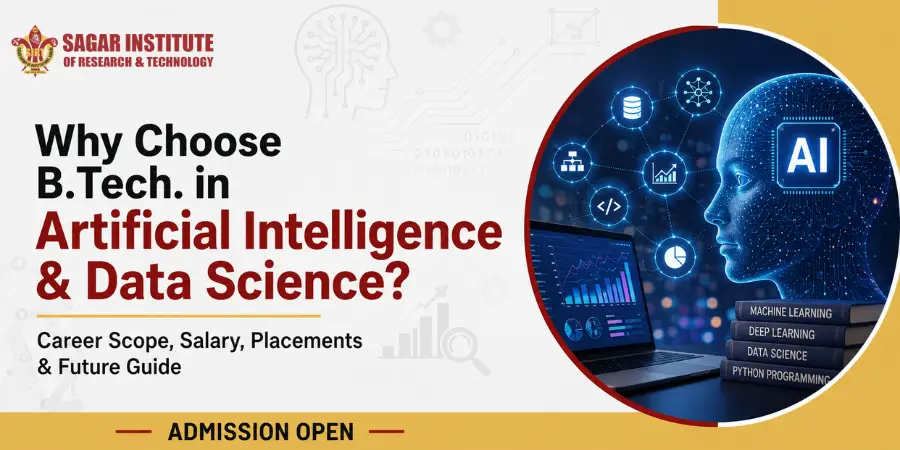
Every industry today - from hospitals to banks to e-commerce - runs on data and automation. At the center of this shift are two disciplines: Artificial Intelligence (AI) and Data Science (DS). Together, they power the recommendation systems on Netflix, fraud detection in UPI apps, diagnostic imaging in healthcare, and the Generative AI tools transforming modern software.
If you are a Class 12 student, a parent, or a career switcher researching top engineering branches in 2026, this guide covers everything you need to know about B.Tech. in Artificial Intelligence & Data Science - syllabus, career opportunities, salary trends, company placements, and how to choose the right college.
Quick Answer
B.Tech. in Artificial Intelligence & Data Science (AIDS) is a four-year engineering degree that blends AI, machine learning, statistics, and big data engineering. In 2026, it is one of the fastest-growing branches in India, with entry-level salaries ranging from ₹4–12 LPA (and up to ₹20–30 LPA at top-recruiting campuses), strong demand from IT, BFSI, healthcare, and GenAI-focused companies, and career paths spanning Data Scientist, ML Engineer, AI Engineer, and NLP Engineer roles.
Table of Contents
- 1. What is B.Tech. in AI & DS?
- 2. Why AI & DS Is the Future
- 3. Why Choose AI & DS?
- 4. AI & DS vs CSE vs AI & ML
- 5. What You'll Learn
- 6. Semester-Wise Journey
- 7. Languages & AI Tools
- 8. Essential Skills Required
- 9. Industry Applications
- 10. Career Opportunities
- 11. Higher Education & Research
- 12. Salary Trends (2026)
- 13. Top Recruiting Companies
- 14. Future Skills for AI
- 15. AI Career Roadmap
- 16. Why Choose SIRT Bhopal
- 17. Admission Information
- 18. Frequently Asked Questions
- 19. Conclusion
1. What is B.Tech. in Artificial Intelligence & Data Science?
B.Tech. in Artificial Intelligence & Data Science is a four-year undergraduate engineering program that teaches students how to build intelligent machines and extract actionable insights from large, complex datasets.
It brings together three core disciplines:
• Artificial Intelligence — building systems that reason, learn, and make decisions autonomously.
• Data Science — collecting, cleaning, analyzing, and visualizing large datasets to drive business decisions.
• Core Computer Science — programming, data structures, algorithms, databases, and software engineering.
Unlike a general CSE degree where AI is one elective among many, an AIDS degree embeds AI, statistics, and data analytics across all four years, giving students specialized skills from day one.
2. Why AI & DS Is the Future of Engineering
AI adoption is no longer optional for companies — it is a competitive necessity. Here is why AI & DS is shaping the future of engineering:
• GenAI is reshaping every job function: Large language models, RAG pipelines, and autonomous AI agents require engineers who understand model building, fine-tuning, and prompt architectures.
• India's digital economy is data-heavy: Government initiatives around Digital India, UPI-scale fintech, and e-governance generate enormous datasets that need trained data professionals to manage and interpret.
• Every sector needs AI talent: healthcare diagnostics, agri-tech, manufacturing automation, logistics optimization, and smart cities all rely on AI & DS-trained engineers.
• Salary premium for AI-specific skills: Recruiters are increasingly paying a premium — industry reports point to candidates skilled in large language model fine-tuning, LangChain-based app development, and vector databases earning noticeably more than peers with only general software skills.
3. Why Choose AI & DS?
Here's why thousands of engineering aspirants are choosing AIDS over traditional branches:
• Early specialization: You build a portfolio in AI/ML from year one instead of picking it up late as an elective.
• Interdisciplinary relevance: AI & DS skills apply across IT, banking, healthcare, retail, manufacturing, and government sectors, so you're not locked into one industry.
• High placement demand: Companies actively recruit for AI/ML and data roles because supply of trained graduates still lags demand.
• Strong long-term earning potential: As you gain 2–5 years of experience, AI/ML specialists typically out-earn generalist software roles at the same experience level.
• Global career mobility: AI and data skills are recognized and in demand worldwide, opening doors to global remote roles and higher studies (MS in AI/Data Science abroad).
• Entrepreneurship opportunities: AI & DS graduates are well-placed to build AI-powered SaaS tools, automation products, and specialized startups.
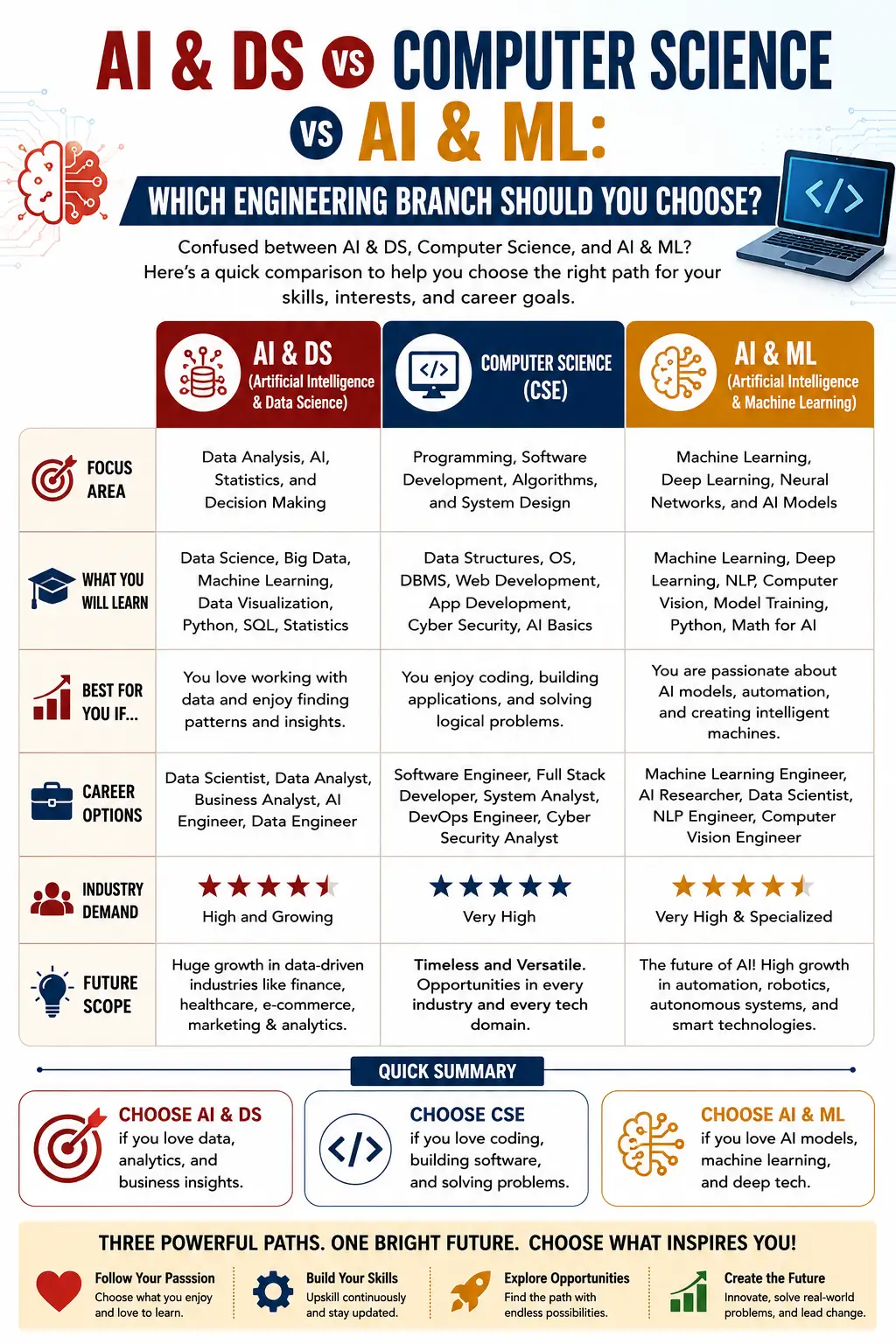
4. AI & DS vs Computer Science vs AI & ML: : Which Engineering Branch Should You Choose?
One of the most common questions students ask after Class 12 is, "Which engineering branch is better—Computer Science Engineering (CSE), Artificial Intelligence & Data Science (AI & DS), or Artificial Intelligence & Machine Learning (AI & ML)?" or "Should I choose AI & DS, CSE, or AI & ML?"
The following comparison will help you understand the differences.
| Feature | B.Tech. in AI & Data Science | Computer Science Engineering (CSE) | B.Tech AI & ML |
|---|---|---|---|
| Primary Focus | Artificial Intelligence, Data Science & Analytics | Software Development & Computing | Artificial Intelligence & Machine Learning |
| Core Subjects | AI, Machine Learning, Data Science, Deep Learning, Big Data | Programming, Networking, Operating Systems, Databases | AI Algorithms, Machine Learning, Deep Learning |
| Programming Languages | Python, R, Java, SQL | C, C++, Java, Python | Python, Java |
| Career Opportunities | AI Engineer, Data Scientist, ML Engineer, AI Consultant | Software Engineer, Full Stack Developer, System Engineer | ML Engineer, AI Developer, Research Engineer |
| Industry Demand | Extremely High | High | High |
While Computer Science Engineering provides a broad foundation in software development and computing, B.Tech. in Artificial Intelligence & Data Science focuses on designing intelligent systems that can analyse data, recognize patterns, and make data-driven decisions. This makes AI & DS an ideal choice for students who want to work on cutting-edge technologies shaping the future.
See also: B.Tech Artificial Intelligence vs. Computer Science: Which Is Better for Your Future?
5. What Will You Learn in B.Tech. in AI & Data Science?
The curriculum of B.Tech. in Artificial Intelligence & Data Science is carefully balanced between computer science fundamentals, mathematical modeling, and practical software implementation. A typical AIDS curriculum covers:
• Programming fundamentals (Python, Java, C++)
• Data structures & algorithms
• Probability, statistics & linear algebra for AI
• Machine learning & deep learning algorithms
• Natural Language Processing (NLP) and Large Language Models
• Computer vision & pattern recognition
• Big data technologies (Hadoop, Spark)
• Database management systems & SQL
• Data visualization & business intelligence
• Cloud computing & MLOps
• AI ethics, bias, and responsible AI
• Capstone industry project in a real-world AI application
This balanced curriculum prepares students to solve real-world business and technology challenges using AI-powered solutions.
6. Semester-Wise Learning Journey
As students’ progress through the four-year program, they gradually move from foundational subjects to advanced domain specializations:
| Year | Focus Area | Key Subjects |
|---|---|---|
| Year 1 | Foundations | Mathematics, Physics, Programming Basics (C/Python), Engineering Graphics, Basic Electronics |
| Year 2 | Core CS + Data Foundations | Data Structures, DBMS, OOP (Java), Probability & Statistics, Discrete Mathematics, Operating Systems |
| Year 3 | AI & Data Specialization | Machine Learning, Deep Learning, Big Data Analytics, Computer Vision, Data Mining, Web Technologies |
| Year 4 | Advanced Applications + Exposure | Generative AI/LLMs, MLOps, AI Ethics, Electives, Major Capstone Project, Industry Internship |
Semester structure varies slightly by university (AICTE/RGPV-affiliated colleges follow a standard model curriculum with periodic updates to include emerging topics like GenAI and LLMs).
7. Programming Languages & AI Tools
Programming is one of the most important skills for AI professionals. During the course, students gain hands-on experience with industry-standard programming languages and development tools.
• Programming Languages: Python, R, Java, C++, SQL
• AI/ML Frameworks: TensorFlow, PyTorch, Scikit-learn, Keras
• Data Tools: Pandas, NumPy, Power BI, Tableau, Apache Spark, Hadoop
• Cloud & MLOps: AWS, Microsoft Azure AI, Google Cloud AI, Docker
• Emerging GenAI Tools: LangChain, vector databases (Pinecone/FAISS), Hugging Face, prompt engineering frameworks, RAG pipelines
Familiarity with these tools — not just theory — is what recruiters test for in 2026 placement drives.
8. Essential Skills Every B.Tech AI & Data Science Student Should Develop
Success in Artificial Intelligence requires much more than technical knowledge. Employers seek professionals who can combine analytical thinking with creativity and problem-solving abilities.
Technical Skills:
Students should focus on developing:
• Strong programming fundamentals (especially Python)
• Statistics & probability application
• Data wrangling and SQL proficiency
• Machine learning model building & evaluation
• Cloud deployment basics
Soft Skills:
Technical expertise must be complemented by professional skills such as:
• Analytical and logical thinking
• Problem-solving under ambiguity
• Communication (translating data insights into business language)
• Curiosity and continuous learning
• Ethical judgment when handling data and building AI systems
These skills help graduates collaborate effectively in multidisciplinary teams and contribute to innovative projects.
9. Industry Applications
Artificial Intelligence has become one of the fastest-growing technologies globally. Organizations across sectors are investing in AI-powered solutions to improve productivity, customer experience, operational efficiency, and business decision-making.
Graduates of B.Tech. in Artificial Intelligence & Data Science can build careers in industries such as:
| Industry | Applications of AI & Data Science |
|---|---|
| Healthcare | Disease prediction, medical imaging, drug discovery |
| Banking & Finance | Fraud detection, credit scoring, algorithmic trading |
| Retail & E-commerce | Product recommendations, customer analytics, demand forecasting |
| Manufacturing | Smart factories, robotics, predictive maintenance |
| Automotive | Autonomous vehicles, intelligent transportation systems |
| Agriculture | Precision farming, crop monitoring, yield prediction |
| Education | Personalized learning platforms, AI tutors |
| Cybersecurity | Threat detection, security automation |
| Media & Entertainment | Content recommendations, video analytics |
| Government & Smart Cities | Traffic management, surveillance, public services |
This wide industry adoption ensures graduates are not restricted to software companies—they can pursue careers across diverse sectors where AI and data-driven decision-making are becoming essential.
10. Career Opportunities after B.Tech AIDS
A B.Tech in AI & Data Science doesn't lead to a single job title — it opens into a cluster of related career tracks, each with a different mix of coding, statistics, and business skill. Here's a closer look at where graduates typically land, what the role actually involves, and which skills matter most for each.
• Data Scientist: Analyzes large, often messy datasets to uncover patterns and build predictive models that inform business decisions — from churn prediction to demand forecasting. Requires strong statistics, Python/R, SQL, and machine learning fundamentals. One of the highest-paying entry points into the field.
• Machine Learning Engineer: Takes ML models from prototype to production — building, training, optimizing, and deploying models at scale. Leans more toward software engineering and MLOps than pure analysis; familiarity with TensorFlow/PyTorch and cloud deployment (AWS/Azure/GCP) is essential.
• AI Engineer: Designs and builds intelligent systems and applications — increasingly focused on integrating large language models (LLMs), building AI agents, and working with frameworks like LangChain and vector databases. This is currently one of the fastest-growing and highest-paid AIDS career tracks due to the GenAI boom.
• Data Analyst: Focuses on interpreting data and communicating insights through dashboards and reports (Power BI, Tableau) rather than building models. A common, accessible entry role for freshers who want to build experience before moving into a Data Scientist or ML Engineer track.
• Business Intelligence (BI) Developer: Builds and maintains the reporting infrastructure — dashboards, data warehouses, and KPI tracking systems — that leadership teams use to make decisions. Strong SQL and data-warehousing skills are key.
• NLP Engineer: Specializes in building systems that understand and generate human language — chatbots, sentiment analysis tools, document summarizers, and LLM-based applications. High demand given the current wave of GenAI adoption across industries.
• Computer Vision Engineer: Builds systems that interpret images and video — used in healthcare diagnostics, manufacturing quality checks, autonomous vehicles, and security/surveillance. Requires deep learning expertise (CNNs, image processing) and often domain-specific knowledge.
• Big Data Engineer: Designs the pipelines and infrastructure (Hadoop, Spark, cloud data lakes) that move and process massive datasets, making them usable for data scientists and analysts downstream. A strong option for graduates who enjoy systems and infrastructure work.
• AI Product Manager: A hybrid role — usually reached after a few years of technical experience — that bridges AI capability with business strategy, deciding what AI features to build and how they create value for users.
• Research Associate: For graduates inclined toward research over industry application, roles in academic or corporate AI research labs focus on advancing model architectures, publishing papers, and experimenting with novel AI techniques — often a stepping stone toward an M.Tech/PhD.
11. Higher Education and Research Opportunities after B.Tech AIDS
Graduates who want to deepen their specialization or move into research and academia often pursue:
• M.Tech in AI / Data Science / ML in India (IITs, NITs, and top institutions via GATE).
• MS in AI or Data Science abroad (US, Canada, UK, Germany, Australia).
• Industry Certifications from Google (Professional ML Engineer, Cloud AI), AWS (Machine Learning Specialty), IBM (AI Engineering), and Microsoft (Azure AI Engineer) — useful either alongside a job or before applying for higher studies
• PhD in AI/ML for those aiming at long-term research careers in academia or corporate research labs.
Career Tips: Freshers often start in a Data Analyst or Junior ML Engineer role and specialize (NLP, computer vision, or MLOps) within the first 2–3 years, once they discover which track suits their interests and strengths best.
12. Salary Trends in India (2026)
Salary depends heavily on college pedigree, internship quality, specialization depth, and GenAI-related project experience. Broad, realistic 2026 ranges reported across Indian placement data:
| Experience Level | Typical Annual Salary (India) |
|---|---|
| Entry-Level (Fresher) | ₹4–8 LPA (at standard institutes); ₹8–15 LPA (at top recruiting campuses) |
| Fresher with GenAI/LLM Skills | ₹6–18 LPA (Premium compensation for high-demand skills) |
| Mid-Level (2–5 Years) | ₹10–20 LPA |
| Senior / Specialized Lead | ₹20–37+ LPA |
Common roles and average salary ranges:
• Data Scientist: ₹6–20 LPA
• Machine Learning Engineer: ₹6–20 LPA
• Data Analyst: ₹4–10 LPA
• AI/NLP Engineer: ₹8–22 LPA
13. Top Companies Recruiting AIDS Graduates
AI & DS graduates are recruited by a wide mix of global tech giants, IT services firms, and analytics-first companies, including:
• Global Tech Giants: Google, Microsoft, Amazon
• IT Services Leaders: TCS, Infosys, Wipro, Cognizant, Capgemini, HCL Technologies
• Analytics & Consulting: Accenture Analytics, MuSigma, Deloitte
• Product & SaaS Companies: Adobe, SAP, PayPal
• Core & Sectoral Leaders: Airbus, Dassault Systèmes, Hexaware, Adani
14. Future Skills for AI Professionals
To stay competitive beyond graduation in 2026 and beyond, master these emerging domains:
• Generative AI & LLM fine-tuning
• Prompt engineering & RAG (Retrieval-Augmented Generation) architectures
• Vector databases and embeddings
• MLOps (deploying, monitoring, and maintaining models)
• AI governance, ethics, and explainability
• Edge AI (deploying models directly on IoT devices)
Domain specialization — combining AI with healthcare, finance, or manufacturing knowledge for higher-value roles
15. AI Career Roadmap
Year 1–2 (College): Build strong math and programming foundations (Python, SQL, DSA).
Year 3 (College): Specialize in ML/DL, Computer Vision, or NLP; work on real datasets.
Year 4 (College): Build a GenAI/LLM capstone project, intern at a tech firm, prepare for campus placements.
Post-Graduation (Years 1–3): Work as a Data Analyst or ML Engineer; gain production model experience.
Senior Level (Years 4+): Step into Lead Data Scientist / AI Architect roles or launch an AI startup.
16. Why Choose SIRT Bhopal for B.Tech AIDS Course?
If you're comparing top engineering colleges in Bhopal for a B.Tech in AI & Data Science, Sagar Institute of Research & Technology (SIRT), Bhopal — part of the SAGE Group — is a strong contender for several reasons:
• Established Legacy: Over 20 years of engineering education experience in Central India.
• Accreditation & Affiliation: AICTE-approved and NBA-accredited programs, affiliated with RGPV (Rajiv Gandhi Proudyogiki Vishwavidyalaya), Bhopal.
• Industry-Aligned Curriculum: Syllabus enriched with inputs and certifications from organizations like Google AI, IBM, AWS, and Microsoft, alongside the RGPV-prescribed framework.
• Strong placement track record: Consistently high placement percentages, with top-recruiting students securing packages well above the branch average, and recruiters spanning IT services, product companies, and analytics firms.
• Dedicated AI/ML Labs: High-performance GPU systems and modern tools for practical hands-on learning.
• Multiple emerging-tech specializations: Alongside AI & DS, SIRT Bhopal offers AI & ML, Cybersecurity, Data Science, IoT & Blockchain, and Cloud Computing tracks — useful if your interests evolve during college.
• Incubation & Startup Support: In-house entrepreneurship development cells to foster innovation.
For students evaluating the best colleges for B.Tech in AIDS in Madhya Pradesh, SIRT Bhopal offers a combination of academic legacy, accreditation, and industry connections that directly influences placement outcomes.
17. Admission Information for B.Tech AIDS after 12th
Eligibility: 10+2 with Physics, Chemistry, and Mathematics (PCM), with minimum aggregate percentage as per AICTE norms.
Admission Route: Admission is conducted through JEE Main scores and state-level MP DTE counselling, or through direct management quota applications at SIRT Bhopal.
Duration: 4 Years (8 Semesters), Full-Time Degree.
Documents typically required: 10th & 12th mark sheets, JEE Main scorecard, category certificate (if applicable), transfer/migration certificate, passport-size photographs.
18. Frequently Asked Questions (FAQs)
Q1. What is B.Tech in Artificial Intelligence & Data Science?
Ans: B.Tech in Artificial Intelligence & Data Science (AIDS) is a 4-year undergraduate engineering degree focusing on AI systems, machine learning models, and big data processing.
Q2. Is B.Tech AI & DS better than CSE?
Ans: Neither is strictly "better". B.Tech AI & DS offers early specialization in data/AI, while CSE offers a broader general software foundation.
Q3. What is the difference between AI & DS and AI & ML?
Ans: B.Tech AIML focuses more on algorithms, models, and intelligent systems, while B.Tech AI & DS adds a stronger emphasis on large-scale data engineering, statistics, and analytics alongside AI.
Q4. What is the average salary after B.Tech AI & DS in India?
Ans: The average salary after B.Tech. in Artificial Intelligence & Data Science in India is ₹4–12 LPA for freshers, while top campus placements can offer ₹15–30+ LPA.
Q5. Which companies hire B.Tech AI & DS graduates?
Ans: TCS, Infosys, Wipro, Accenture, Amazon, Microsoft, Deloitte, Cognizant, and emerging AI startups.
Q6. How to apply for B.Tech AI & DS at SIRT Bhopal?
Ans: To apply for B.Tech. AI & DS at SIRT Bhopal, candidates can register through MP DTE counselling using their JEE Main score or apply directly via the official SIRT Bhopal admission portal.
Q7. What is the fee range for B.Tech AI & DS in private colleges?
Ans: The fee for B.Tech. AI & DS in private colleges generally ranges from ₹50,000 to ₹5,00,000 per year, depending on the college, infrastructure, and location.
Q8. What is the eligibility for B.Tech AI & DS admission?
Ans: The eligibility for B.Tech. AI & DS admission is 10+2 with Physics, Chemistry, and Mathematics (PCM), typically with a minimum of 45% aggregate marks, along with a valid JEE Main score or as per the admission criteria of the respective engineering college.
Q9. Is B.Tech AI & DS a good career choice in 2026?
Ans: Yes, B.Tech. AI & DS is an excellent career choice in 2026, as the growing adoption of AI and Generative AI across industries continues to create strong demand for skilled AI and data science professionals.
Q10. Can I pursue higher studies after B.Tech AI & DS?
Ans: Yes. Popular options include M.Tech in AI/Data Science, MS abroad in AI/ML, or specialized industry certifications from Google, AWS, IBM, and Microsoft.
Q11. Is coding difficult in B.Tech AI & DS?
Ans: No, coding in B.Tech. AI & DS is taught step by step, starting with programming basics like Python and C. With regular practice, beginners can easily build the skills required for AI and data science.
Q12. Are there internship opportunities during the B.Tech AIDS?
Ans: Yes, most AI & DS programs include mandatory or recommended internships in the third or fourth year, often facilitated through college placement cells and industry tie-ups.
Q13. What is the scope of AI & DS outside India?
Ans: AI and data skills are globally in demand, and this degree can support careers or higher studies (MS) in the US, Canada, UK, Germany, Australia, and other tech hubs.
Q14. Can B.Tech AI & DS graduates start their own startup?
Ans: Yes. With growing access to affordable cloud and GenAI tools, AI & DS graduates are well-positioned to build AI-powered products with relatively low upfront infrastructure cost.
19. Conclusion
B.Tech. in Artificial Intelligence & Data Science sits at the intersection of two of the most valuable skill sets in today's economy: building intelligent systems and making sense of data at scale. With GenAI accelerating demand across every industry, students who choose this branch — and pair it with a college that offers genuine industry exposure, strong labs, and a proven placement record - are positioning themselves for one of the most resilient and rewarding engineering careers available in 2026 and beyond.
If you're shortlisting a top-ranked engineering college for this program, look closely at accreditation, curriculum currency (does it include GenAI/LLM content?), lab infrastructure, and actual recruiter lists - not just brochure claims. SIRT Bhopal, with its two-decade legacy, RGPV affiliation, NBA accreditation, NAAC A accreditation and consistent placement outcomes, is worth serious consideration among the best colleges for B.Tech in AIDS in Central India.
Related Blogs
BTech AIML Engineering: Course Details, Admission, Fees, Syllabus, Scope, Career
B.Tech CSE Course Details, Admission, Fees, Syllabus, Career Options