
Every year, we meet hundreds of excited, nervous, yet ambitious students who step into this institution with dreams of building robots, developing new technologies, or securing a great placement. Four years later, while some students do manage to achieve this, many leave wondering where the time went.
What we've observed, interestingly, is that intelligence is rarely the differentiating factor. Often, it's a student's habits, priorities, and choices that make a much larger impact than raw talent ever could.
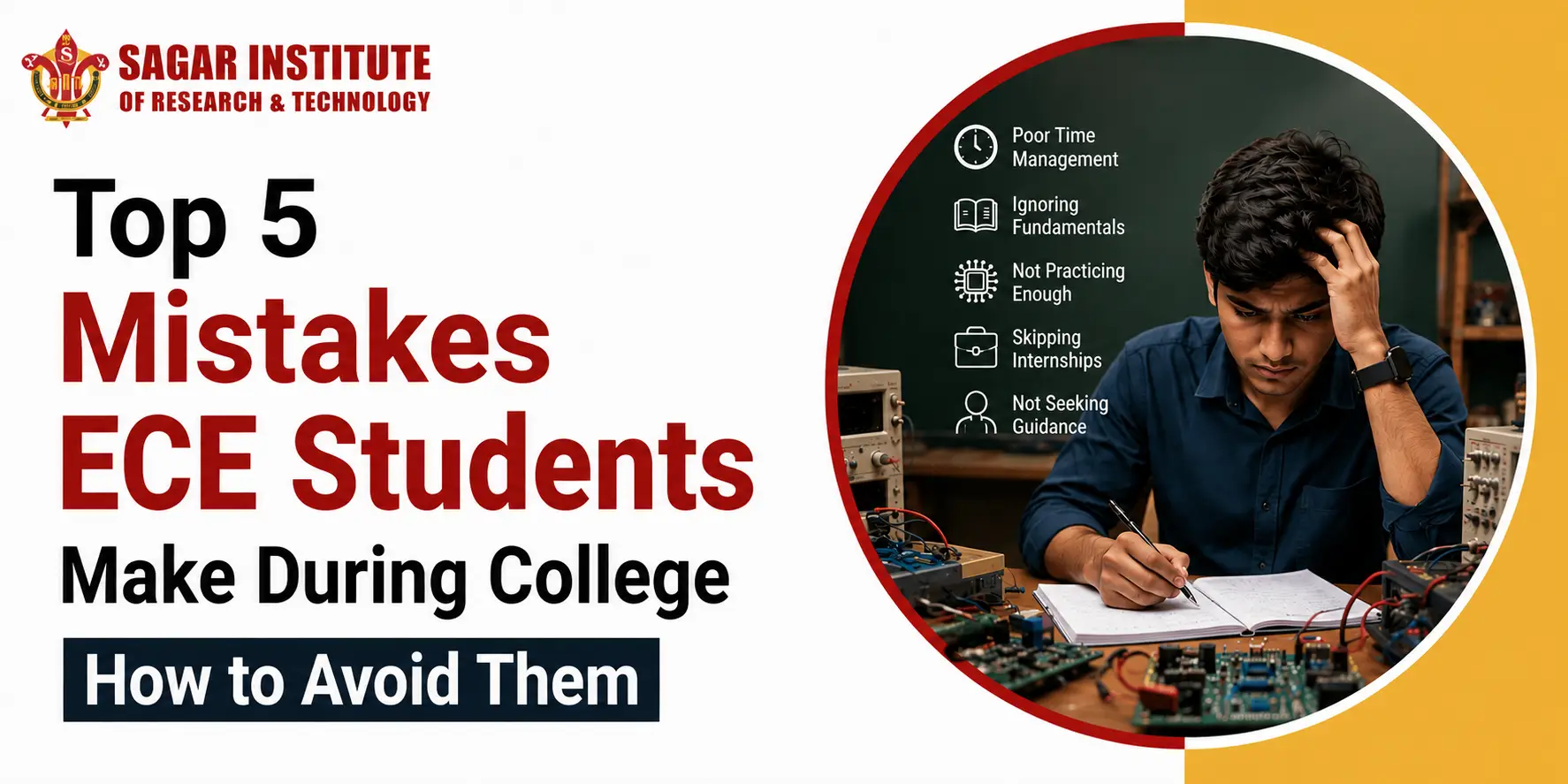
After years of teaching Electronics and Communication Engineering (ECE), here are the five mistakes ECE students make in college most often - and our honest tips for ECE students on how to avoid them. While these patterns show up across every branch, this is our take on the common mistakes engineering students make, specifically from an ECE perspective.
1 1. Studying Only to Pass Exams
While some students can ace exams by memorizing formulas the night before, it's worth understanding the long-term cost of this habit. Students who focus only on passing exams often struggle later - during internships, technical interviews, and real industry projects - because these situations demand understanding, not recall.
Marks matter, but real knowledge matters more. An interviewer can tell within minutes whether a candidate understands a concept or has simply memorized it for a semester.
How to fix it:
• After every topic, ask yourself: "Could I explain this to a junior student without notes?"
• Solve numerical and conceptual problems beyond what's asked in exams, not just past papers.
• Treat assignments and lab work as learning opportunities, not formalities to complete.
2 2. Ignoring the Fundamentals
Many students rush through foundational courses because they seem difficult or "boring," only to realize later that advanced subjects — and even placement interviews — are built entirely on them.
In ECE, subjects like Network Theory, Digital Electronics, Signals and Systems, Electronic Devices, and Communication Systems aren't just papers to clear. They form the base on which everything else — VLSI, embedded systems, communication engineering, signal processing - is built. Understanding this early is one of the simplest ways to figure out how to succeed in ECE engineering long before placements roll around.
How to fix it:
• Never treat a "core" subject as something to just get through. Revisit it if you didn't understand it well the first time.
• Connect fundamentals to real applications early — ask "where would I actually use this?"
• Build a strong base in your first two years; it pays off disproportionately in your third and fourth.
3 3. Depending Entirely on Classroom Teaching
Listening to lectures and taking notes is important - but it's only the first step, not the whole process. To truly internalize a concept, you need to go beyond the classroom: revise regularly, ask doubts without hesitation, read research papers when possible, and most importantly, get your hands on practical experimentation.
Extra effort is always rewarded, even when it doesn't feel like it in the moment.
How to fix it:
• Spend at least a few hours a week outside class revisiting what was taught.
• Don't hesitate to ask "silly" questions — they're usually the ones everyone else has too.
• Use labs, simulation tools, and small personal projects to see theory come alive.
4 4. Waiting Until the Final Year to Build Skills
In reality, your resume starts building from your first semester - not your final year.
We always advise students that whether it's programming, embedded systems, VLSI, IoT, MATLAB, or communication skills, consistent learning spread across four years is far more effective than last-minute cramming before placements. As a bonus, consistency also looks good on paper - it shows recruiters that you take your growth seriously, not just your job search.
How to fix it:
• Pick one or two skill areas early (e.g., embedded systems or a programming language) and build on them every semester.
• Use summer and winter breaks for short certifications, projects, or internships — don't just rest.
• Start a portfolio or GitHub profile as early as your second year, even with small projects.
5 5. Chasing Every Trend
Today, students are constantly talking about AI, Machine Learning, Cybersecurity, Robotics, and countless other emerging technologies — and it's easy to feel like you're falling behind if you're not learning all of them at once.
Our advice: build strong fundamentals first. Once your basics are solid, learning new technologies becomes significantly easier, because you're no longer learning in isolation — you're connecting new tools to concepts you already understand deeply.
How to fix it:
• Don't abandon a subject halfway because a "trendier" one caught your attention.
• Pick one emerging area to explore seriously each year, rather than sampling everything shallowly.
• Remember: recruiters value depth in one or two areas far more than a shallow list of buzzwords.
Quick Recap
| Mistake | Quick Fix |
|---|---|
| Studying only for exams | Focus on understanding and application, not memorization |
| Ignoring fundamentals | Treat core ECE subjects as the foundation, not a hurdle |
| Relying only on classroom teaching | Supplement lectures with revision, doubts, and hands-on practice |
| Delaying skill-building | Start building skills from semester one, not final year |
| Chasing every trend | Build strong basics first, then explore emerging technologies |
Frequently Asked Questions
Final Thoughts
The four years you spend in engineering college shape the foundation of your entire career. It's a period for building not just technical knowledge, but skills, confidence, and professional identity. A successful engineering career isn't created overnight - it's built through consistent effort, curiosity, discipline, and a willingness to learn beyond the classroom.
As professors, we don't celebrate only the students who score the highest marks. We celebrate the ones who keep improving, stay curious, and embrace challenges along the way. If you can avoid these engineering college mistakes, you won't just become a better engineering student - you'll become a better engineer. This is, in essence, the core piece of ECE student advice we'd give our younger selves too.